What separates a medical scrub manufacturer you can reorder from for years is not visible in photos. It is who owns the fabric, who runs the cutting table, and who answers when a reorder arrives in the wrong shade.
Five checks and one question list turn that into a decision you can document. NIAAHINN has produced medical apparel in Wuhan, China, since 2017, running fabric development, garment production and delivery as one chain, and serving clinics, distributors and brands in more than 80 countries.
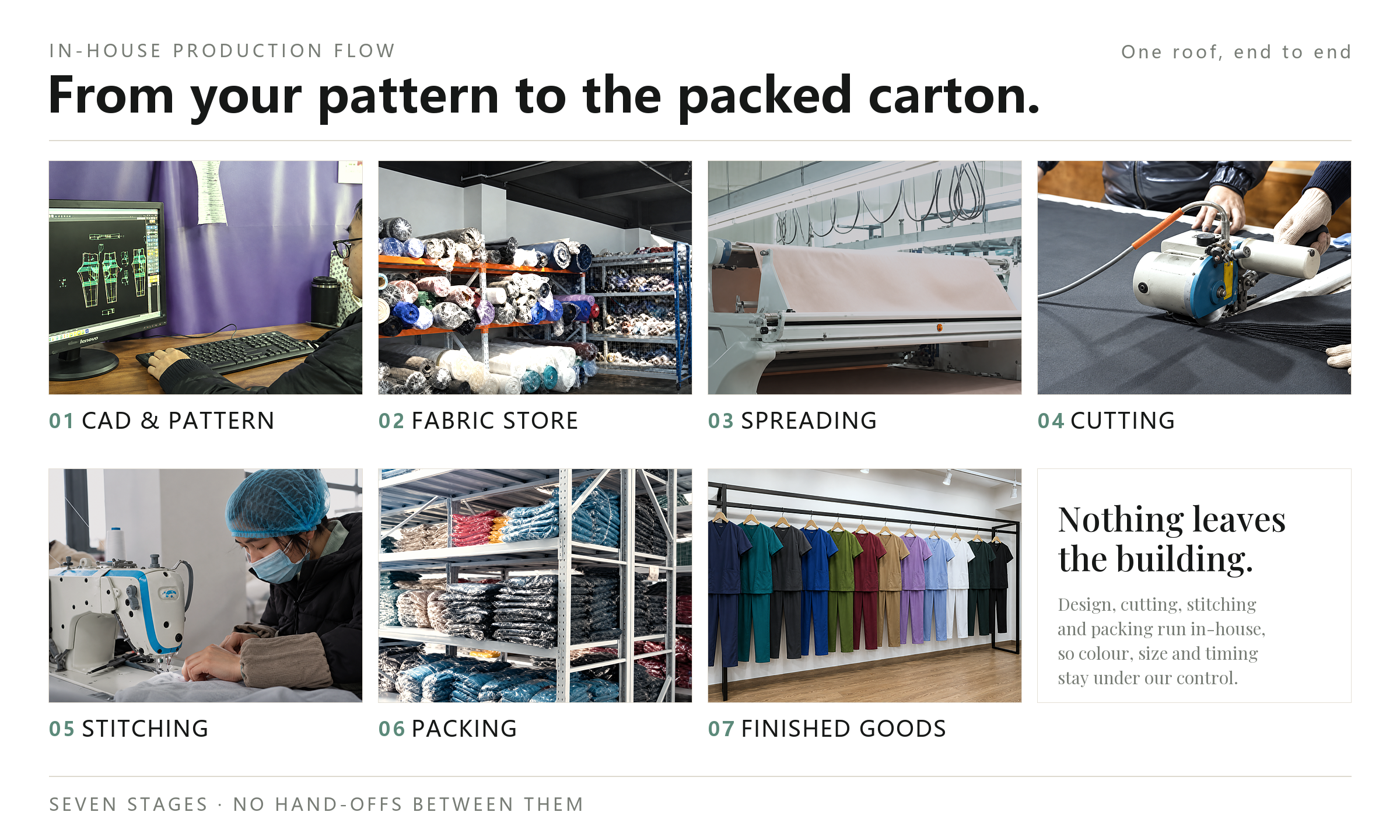
Start with one question: do you produce the fabric, or buy it finished? A supplier that buys finished rolls controls neither shade consistency between batches nor hand feel between order.
| Supplier type | Fabric control | Effect on your program |
| Trading company | None; sources per order | Shade and hand feel can shift between orders |
| Sewing factory | Buys finished rolls | Quality depends on a mill you cannot audit |
| Full-chain manufacturer | Owns fabric production and garment making | Fabric questions reach the people who made it |
NIAAHINN develops fabric in-house, so composition and finish are set at the fabric stage, and its TS and TRS fabric compositions are published for review.
Ask what equipment the cutting room runs and where inspection happens. Automatic cutting improves pattern precision. Inspection should cover incoming fabric, work in progress and finished garments, not only the final carton.
A supplier that can name those stages and show ISO 9001, CE and GSG certificates plus an independent supplier assessment report is describing a system, not a promise.
Uniform programs fail at reorder time, months after the first delivery. Ask:
Which colors are stocked, and which are dye-to-order?
What is the standard size range, and can you cut outside it?
How fast is in-stock replenishment?
How do you match color when we repeat the same code?
NIAAHINN holds core colors and sizes without lead time, runs XS to 2XL as standard, and processes in-stock replenishment within 24 hours; sizes and colors outside that range are quoted on request.
"Custom" means different things to different suppliers. When you brief custom medical uniforms, ask for the boundary: colors matched to your palette, neckline and pocket position, sleeve length, extended sizing, and branding through embroidery, heat transfer, custom hangtags or branded packaging.
If the answer is "anything," ask for a sample; the medical scrub range shows how these options appear in finished styles.
Ask what happens when something is wrong. NIAAHINN accepts quality objections within seven days of delivery for fabric defects, stitching errors and size discrepancies, provided the garments are unused and unwashed, and assigns a dedicated account manager to bulk orders.
Eight questions for medical uniform supplier vetting
Do you produce the fabric yourselves, or buy it finished?
Which fabric compositions do you run regularly?
What cutting equipment do you use, and where are your inspection stages?
Which certifications can you provide as documents?
Which colors and sizes do you hold in stock?
How fast can you replenish an in-stock color?
What can be changed on a style, and what is fixed?
What is your process when a delivery does not match the approved sample?
Send the same list to every medical scrub manufacturer or wholesale scrubs supplier you compare — identical questions are what make quotes comparable.
Should I choose a manufacturer or a trading company?
A trading company can be faster for small, varied orders. A manufacturer is usually the better route once color consistency, reorder reliability and design changes matter, because fabric and garment come from one operation you can hold to one specification.
How many manufacturers should I compare?
Three to five, using the same written question list. Fewer than three and you have no benchmark; more than five and the differences stop being meaningful.
Do we need to visit the factory?
A video walk through of the cutting room, production floor and sample room covers most of the assessment. A visit earns its cost when choosing between two suppliers who answered every question well.
Send your size distribution, color target and logo artwork, plus the eight questions above, through the contact page. The team can share fabric options and customization limits before you order, and you can read more about the production setup.

 EN